


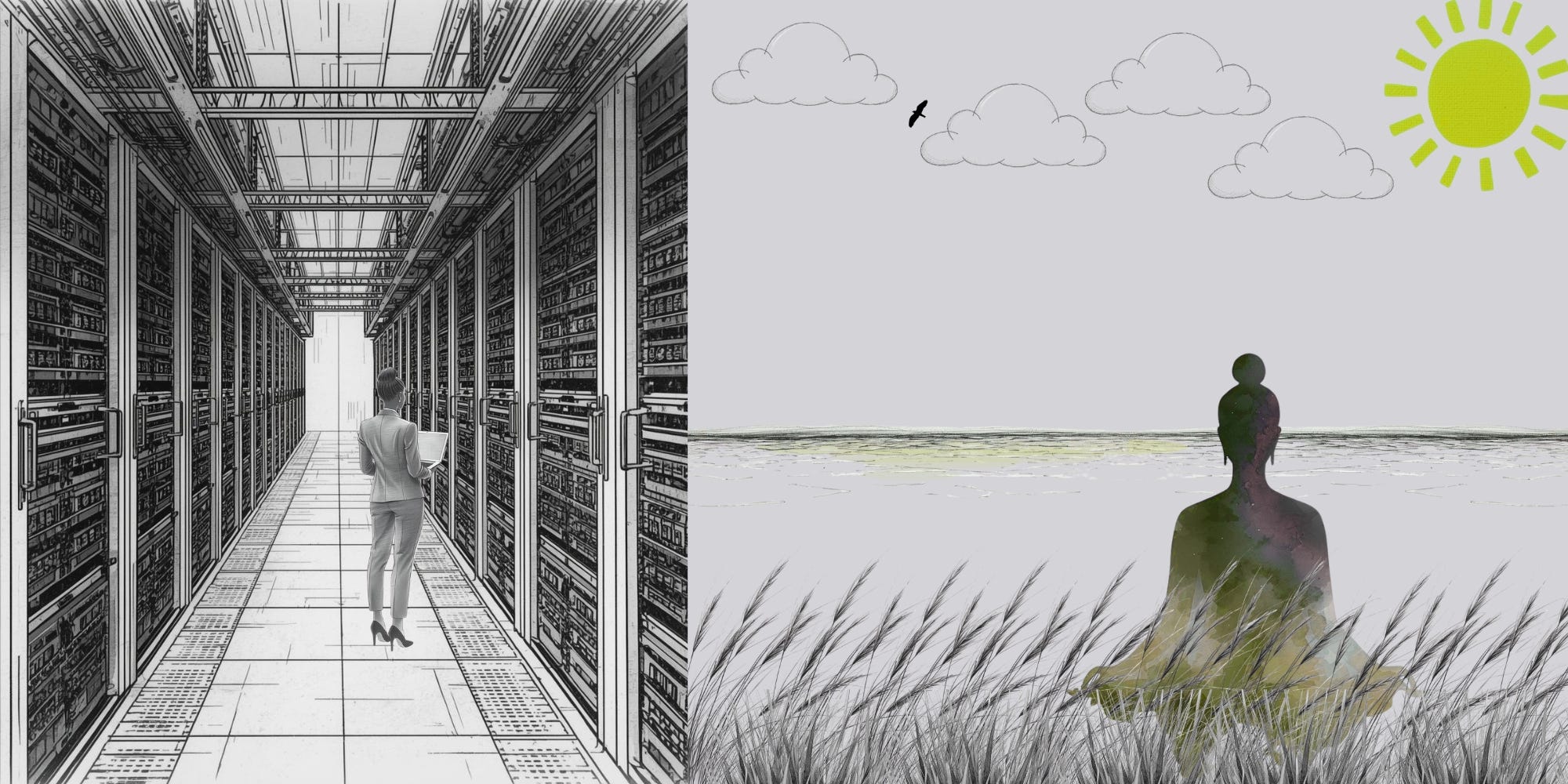
AI needs water to function.
We need it to feel alive.
This is not a condemnation of AI. In fact, I actively use it in my daily life, and I’ve spent the past year studying how it can transform organizations, including AI leadership principles and best practices for responsible implementation.
However, something else can also be true: the faster AI accelerates, the more we need to rekindle what makes us human. Understanding AI more deeply has only made me more aware of what it cannot (and should not) replace.
When acceleration demands slowing down
With the rapid pace of AI adoption, it’s even more important to learn when to slow down, smell the roses, and tap into what we can experience IRL. Unfortunately, many of us need a vacation just to remember what roses smell like.
It’s important to embolden ourselves and recapture the elements that are key to our sense of connection and community. As humans, we need nature, sunlight, and water — key elements that make us inherently living beings — not as luxuries but as conditions of existence.
Many of us only revisit this mindset on holiday, when we finally give ourselves the space to savor it. But even this approach is a false start, since the majority aren’t taking the vacations they’ve earned and have a right to.
More than half of Americans (55%) are not using all of their paid vacation time. (Forbes Advisor)
People spend about 90% of their time indoors, where pollutant levels can be 2-5 times higher than outdoors. (EPA)
The basics we keep forgetting
You might say yes, of course, this is obvious. Most people agree that access to nature supports healthy living, but in practice, this is where we often fall short, particularly in western societies.
Our most basic needs are fresh air, water, and movement. Scientific Reports recommends ~120 minutes per week outside in nature, a threshold linked to better health and wellbeing. Yet there has been a long-term decline in time outdoors.
Modern life has engineered nature out of our routines. Our daily commutes rarely involve walking or cycling. Our screen time, both in professional and personal settings, overpowers our lives, and our busy schedules dictate every available moment. We move from home to car, building to building, screen to screen, rarely taking the time to be still.
Greater exposure to natural environments (such as parks, woodlands and beaches) is associated with better health and wellbeing. (Scientific Reports)
Time in nature has been linked to better mental health…and provides a combination of stimulation of different senses and a break from typical overstimulation from urban environments. (Harvard T.H. Chan)
Artificial Intelligence ≠ Artificial Experience
We can curate vacations and excursions with the help of AI, even leverage it as a de facto travel agent, who knows our preferences, flight schedules, interests, and credit card details. It can describe what it’s like to stare out across Paris from the Eiffel Tower, but only we can truly experience the Parisian air, the sunlight on our faces, and the expansive views.
If screen time is increasing and time outside is decreasing, will the future be a world where we just watch videos of outdoor activities? Perhaps we opt to interact with simulated digital environments rather than getting outside and exploring the world ourselves.
If we’re not careful, we may outsource the very experiences that remind us we’re alive.
“There is more to life than increasing its speed.” - Mahatma Gandhi
The irony of water
And here’s the irony: AI needs water too. Data centers require a substantial amount of water to cool their servers. According to the Environmental and Energy Study Institute, a large data center can use up to 5 million gallons per day, which is equivalent to a town of 10,000 - 50,000 people. Google alone used approximately 8.1 billion gallons of water in 2024.
And here’s the vicious cycle: As data center energy use increases, so do carbon emissions. As our demand for AI grows, so does the construction of facilities to power it. The more emissions we generate, the more our outdoor air quality deteriorates. The more we stay indoors, the more we expose ourselves to indoor pollutants.
And here’s the uncomfortable truth: We’re stuck in a loop that pulls us away from the world our bodies were designed for.
AI needs water to run. We need water to flourish — to feel, to connect, to experience the world around us.
AI’s needs are mechanical.
Ours are existential.
In a moment when technology is accelerating faster than our ability to process it, the risk isn’t that AI becomes human, but that we forget to be.